 Admin
Admin You probably underestimate your subscription bill by half. That’s not a guess — it’s data.
According to C+R Research, the average American spends $219 per month on subscriptions, but estimates only $86. That’s a $133/month perception gap, or about $1,600 a year you’re spending without realizing it. A separate 2026 RecurStop analysis puts household subscription spending even higher — around $273/month, with the average person carrying 8.2 active subscriptions at once.
Here’s the worst part: 42% of Americans admit they’ve forgotten about at least one subscription they’re paying for, and 54.9% say they have at least one unused subscription billing them every month. CNET estimates the typical adult wastes around $200 per year on services they don’t use — and that’s just the unused ones, not the underused ones.
If you’re serious about saving and budgeting, this is the easiest money you’ll ever recover. No spending freeze. No second job. Just 30 minutes and a willingness to cancel.
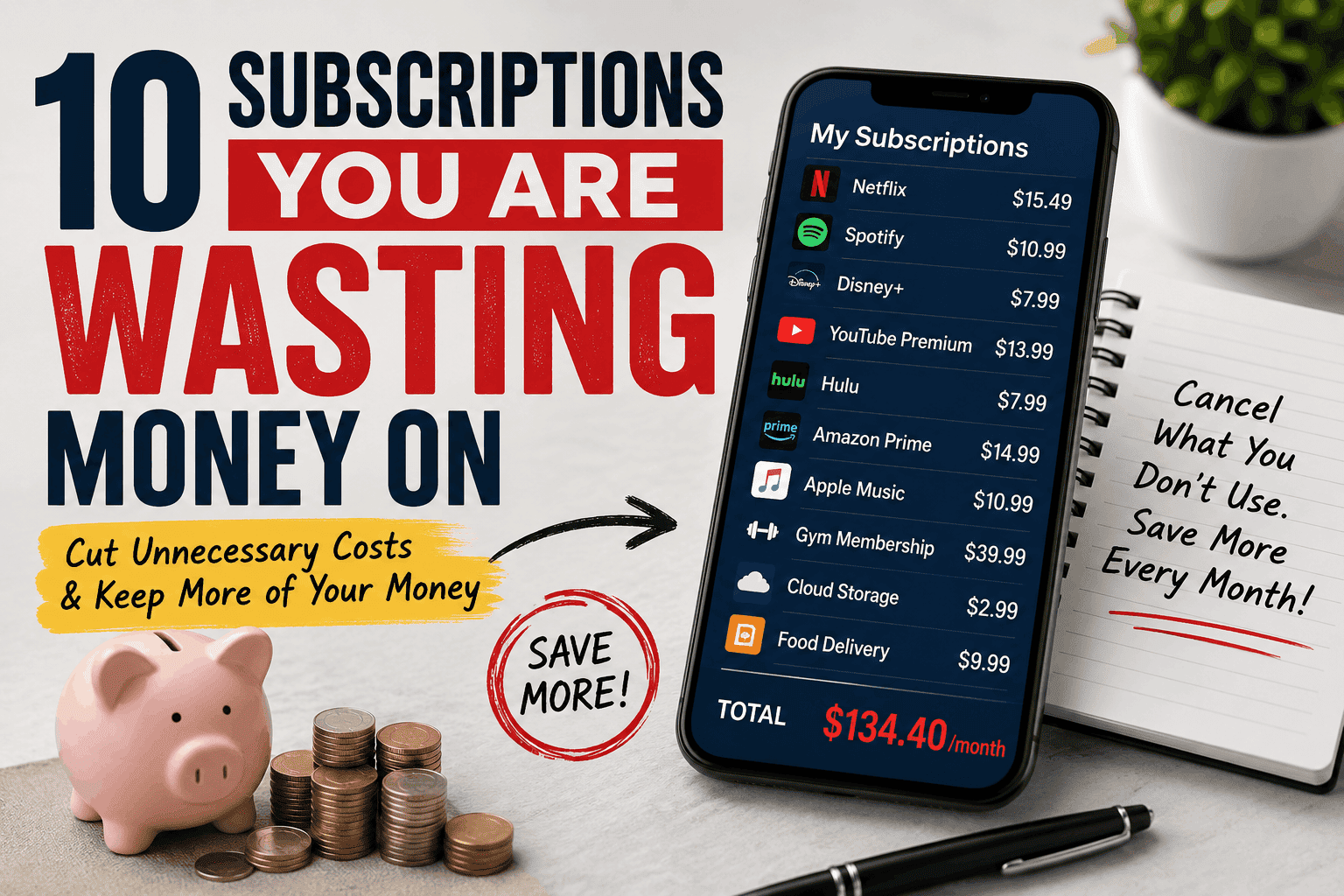
Here are the 10 subscriptions wasting money for most American households in 2026 — and exactly what to do about each one.
Quick Answer: Which Subscriptions Waste the Most Money?
The biggest money-wasting subscriptions for the average American household are: duplicate streaming services, unused gym memberships, premium app trials that auto-renewed, cloud storage you don’t need, meal kit deliveries, redundant music streaming, identity theft protection that overlaps with free services, premium news subscriptions you never read, gaming subscriptions, and forgotten subscription boxes. Canceling just three to four of these typically saves $80–$150 per month.
Now let’s break down each one.
1. Stacked Streaming Services You Don’t Actually Watch
Average cost in 2026: $69/month for the typical household with 4.5 streaming services Potential annual waste: $360–$600
The Deloitte 2025 Digital Media Trends report found that the average American household pays for 4–5 streaming services simultaneously. Industry data shows roughly one-third of those subscriptions go completely unused each month.
Here’s the math on how it adds up in 2026:
| Service | Ad-Free Monthly Cost |
|---|---|
| Netflix Premium | $24.99 |
| Disney+ (no ads) | $18.99 |
| Max (Ad-Free) | $20.99 |
| Hulu (No Ads) | $18.99 |
| Apple TV+ | $12.99 |
| Paramount+ with Showtime | $12.99 |
| Peacock Premium Plus | $16.99 |
If you have just four of those, you’re at roughly $80/month — almost $1,000 a year.
The fix: Adopt a “rotate and cancel” strategy. Subscribe to ONE service for a month, binge what you want, cancel, move to the next. Most streamers let you re-subscribe instantly with no penalty. Or switch to the ad-supported tier — it cuts cost by 30–50% with surprisingly few ads.
2. The Gym Membership You Visit Twice a Month
Average cost in 2026: $37–$80/month (premium gyms can hit $200+) Potential annual waste: $440–$960
Gym membership waste is one of the most well-documented financial leaks in personal finance. Studies have consistently shown that the majority of new members visit fewer than four times per month after the first 90 days — meaning they’re often paying $10–$25 per visit on what was supposed to be a flat monthly rate.
If you haven’t scanned your gym tag in the last six weeks, the membership isn’t a fitness expense — it’s a guilt subscription.
You can find another article here: How to Save $10,000 in 12 Months
The fix:
- Switch to a budget gym like Planet Fitness ($15–$25/month) if you go occasionally
- Try a class-pass model (ClassPass) if you want variety without commitment
- Use free YouTube workouts plus a $0 walking habit — both work better than an unused gym
- If you genuinely use the gym 12+ times a month, keep it. Otherwise, cancel.
3. Duplicate Cloud Storage You Forgot You’re Paying For
Average cost in 2026: $2.99–$9.99/month per service Potential annual waste: $120–$360
This is one of the sneakiest categories. According to JustCancel’s 2026 subscription research, 22% of consumers pay for duplicate services like iCloud + Google One + Dropbox simultaneously. Phones automatically push you to upgrade iCloud when storage fills up. Google does the same with Google One. Many people end up paying for both, plus a Dropbox tier they signed up for in 2018.
The fix: Pick one ecosystem and consolidate.
- iPhone-heavy household? iCloud+ ($2.99–$9.99/month) covers most needs
- Android/Google household? Google One ($1.99–$9.99/month) does the same
- Desktop power user? Dropbox or OneDrive (Microsoft 365 includes 1TB)
Cancel the other two. You’ll save $5–$30/month and your files will be easier to find.
4. Premium Music Streaming (When You Already Pay for Another)
Average cost in 2026: $11.99/month individual, $19.99/month family Potential annual waste: $144–$240
Roughly 33% of Americans pay for a music streaming service. The waste happens in two scenarios:
- You pay for Spotify Premium AND Apple Music because of a free trial that auto-renewed
- You pay individual when your household qualifies for family — splitting a $19.99 family plan among 6 people drops the per-person cost to $3.33
Even worse, some people pay for Spotify, Apple Music, and YouTube Premium (which includes YouTube Music). That’s $35+/month for the same songs.
The fix: Pick one. Use the free tier of the others if you ever need them. If you have a household, switch to family plans — the savings often exceed 60%.
5. Meal Kit Subscriptions That Pile Up in the Fridge
Average cost in 2026: $90–$140/week (HelloFresh, Blue Apron, Factor, Home Chef) Potential annual waste: $500–$2,000+
Meal kits make sense when you actually cook them. The problem? Industry data shows the average meal kit subscriber skips roughly 40% of weeks but doesn’t always pause the box in time. The kits arrive, sit, and either get cooked late (food waste) or get charged-and-pushed-to-next-week (money waste).
A two-person HelloFresh box at the typical $11.99/serving across 3 meals = $71/week, or roughly $300/month. If you only cook half the boxes you receive, your real cost per meal cooked doubles.
The fix:
- Pause the subscription for 4 weeks and see if you miss it
- Try meal prep (you batch-cook on Sunday) instead — costs roughly 60% less
- If you keep it, set a calendar reminder to skip weeks proactively
6. Forgotten Free Trials That Auto-Renewed Into Annual Plans
Average cost in 2026: Varies — typically $9.99–$99.99/year Potential annual waste: $50–$300
This one stings. According to C+R Research, 48% of Americans have been charged after forgetting to cancel a free trial — and JustCancel’s 2026 data puts that figure even higher at 64.8%. Common offenders include:
- Language apps (Duolingo Super, Babbel, Rosetta Stone)
- Photo editors (Lightroom, VSCO, Picsart)
- Meditation apps (Calm, Headspace)
- AI tools (ChatGPT Plus, Midjourney, etc.) signed up “just to test”
- Dating app premium tiers (Tinder Gold, Hinge+, Bumble Premium)
The trick? They charge annually, so a $99 hit feels like one bad day instead of a recurring drain — and it often slips past unnoticed.
The fix:
- Search your email for “free trial” and “subscription confirmation” — work back 12 months
- Use a virtual card service (Privacy.com, Capital One Eno) for trials so you can shut off charges instantly
- Set a phone calendar reminder for one day before any trial ends
7. Identity Theft Protection You’re Paying for Twice
Average cost in 2026: $9.99–$29.99/month (LifeLock, Aura, IdentityIQ, Identity Guard) Potential annual waste: $120–$360
This is one of the most overlooked subscriptions wasting money. Most premium credit cards already include free credit monitoring, dark web scanning, and identity theft insurance. Many bank accounts and even Experian and Credit Karma offer the same monitoring features for $0.
If you’re paying $20/month for LifeLock while your Chase Sapphire card already gives you the same coverage for free, you’re double-paying for the exact same protection.
The fix:
- Check your credit card benefits portal for free monitoring (most premium cards have it)
- Use the free credit alerts from Credit Karma, Experian, or your bank
- Freeze your credit at all three bureaus (it’s free, fast, and more effective than monitoring)
8. Premium News Subscriptions You Never Open
Average cost in 2026: $4–$25/month per outlet (NYT, WSJ, Washington Post, Bloomberg, The Athletic, Substacks) Potential annual waste: $100–$400
Premium news has a unique waste pattern: people sign up during major news cycles (an election, a market crash, a sports season), read for two weeks, then forget. The charges keep coming for 11 months.
A common 2026 stack looks like:
- New York Times All Access — $25/month
- Wall Street Journal — $9.99/month (intro), then $38.99
- The Athletic — $9.99/month (often bundled with NYT but paid separately)
- Two random Substacks — $5–$10/month each
That’s easily $50–$80/month for content most people consume primarily through free social media and email summaries anyway.
The fix:
- Audit which outlets you’ve actually read in the last 30 days
- Most papers offer 50–70% discounts if you “cancel” — they’ll email a retention offer
- Consider a library card — most US public libraries give free access to NYT, WSJ, and major magazines through apps like PressReader
9. Gaming Subscriptions That Overlap
Average cost in 2026: $9.99–$19.99/month Potential annual waste: $120–$360
Many gamers stack:
- Xbox Game Pass Ultimate — $19.99/month
- PlayStation Plus Premium — $17.99/month
- Nintendo Switch Online — $3.99/month
- Apple Arcade — $6.99/month
- EA Play, Ubisoft+, etc.
If you’re not actively playing on multiple platforms each month, you’re paying for libraries you’ll never touch. Plus, many games on Game Pass Ultimate are also available on PS Plus — you’re paying twice for the same titles.
The fix:
- Pick one platform per quarter based on what’s coming out
- Cancel and resubscribe — most services let you back in instantly
- For Xbox: pay annually for Game Pass Core ($59.99/year vs. $239.88 monthly Ultimate)
10. Subscription Boxes (Beauty, Snacks, Hobbies)
Average cost in 2026: $15–$60/month Potential annual waste: $180–$720
Subscription boxes — Birchbox, Ipsy, FabFitFun, BarkBox, monthly book clubs, coffee subscriptions, sock-of-the-month — are designed to feel like a small treat. The problem: most subscribers report using less than 50% of what arrives, and many boxes accumulate unopened.
The psychological hook is “You’re getting more than you pay for.” The reality is you’re getting more stuff than you wanted, picked by someone else, on a schedule that doesn’t match your actual needs.
The fix:
- Apply the “would I buy this individually right now?” test
- Pause for one cycle — if you don’t miss it, cancel
- For curated boxes, switch to buying full-size products of items you actually loved from past boxes
Bonus: The Subscription You Should Audit Today
Beyond the 10 above, scan your statements for these often-forgotten lines: Amazon Prime add-ons (Prime Video Channels like Paramount+ billed through Amazon are notorious), Adobe Creative Cloud single-app subscriptions, Audible credits piling up unused, dating app premium tiers, and old domain or web hosting renewals.
How to Audit Your Subscriptions in 15 Minutes
The single fastest way to recover money is a focused audit. Here’s the process:
- Pull last 90 days of statements for every checking account and credit card
- Search for recurring charges — anything billing the same amount monthly, quarterly, or annually
- List them in a spreadsheet with name, cost, billing date, and last time you used it
- Cancel anything you haven’t used in 30 days — be ruthless
- Set calendar reminders to re-audit every 90 days
Apps that automate this: Rocket Money, Monarch Money, and Trim will scan your accounts and flag subscriptions, often offering one-tap cancellation. Most free up $80–$150/month for the average user on the first audit.
A Note on Cancellation Difficulty in 2026
The FTC’s “click-to-cancel” rule was struck down in mid-2025, meaning many companies still make cancellation deliberately painful. Per JustCancel’s analysis of 1,189+ subscription services, 143 use what researchers call “dark patterns” — multi-step phone calls, hidden cancel buttons, retention loops, and misleading prompts.
A bipartisan Unsubscribe Act was introduced in Congress in early 2026 to address this, requiring companies to make cancellation as simple as signup. As of this writing, the bill is still in committee.
Until then, your best tool is a virtual credit card or, in extreme cases, requesting a new card number from your bank to forcibly cut off persistent billers.
Frequently Asked Questions
How much money does the average American waste on subscriptions?
The average American spends $219–$273 per month on subscriptions but estimates only $86–$111 — a perception gap of $130–$160 monthly. Of that, CNET estimates roughly $200/year is purely on services consumers don’t use, while broader analyses including underused services put the waste closer to $500–$1,000/year per household.
What’s the easiest subscription to cancel?
Streaming services are typically the easiest — most can be canceled in 2–3 clicks from the account settings page. Gym memberships, news subscriptions, and SaaS tools tend to be the hardest, often requiring phone calls or written requests.
How do I find subscriptions I forgot about?
Three methods work best: (1) review 3–6 months of bank and credit card statements line by line, (2) search your email for “thanks for subscribing,” “free trial,” and “auto-renewal,” (3) use an app like Rocket Money or your bank’s built-in subscription tracker (Chase, Wells Fargo, and Bank of America all offer this in 2026).
Are subscription audits really worth the time?
Yes. The average household frees up $80–$150/month after one focused audit — that’s $960–$1,800 per year recovered for roughly 30 minutes of work. Few financial habits offer that hourly return.
Should I cancel everything and start over?
Not necessarily. Cancel ruthlessly, but keep the one or two subscriptions you genuinely use weekly. The goal isn’t zero subscriptions — it’s only paying for what delivers real value. A useful rule: if you used it in the last 14 days, it stays. If you didn’t, it goes.
Final Thoughts
Subscription creep is one of the most expensive financial habits in America — and one of the easiest to fix. You don’t need willpower, a budget overhaul, or a side hustle. You just need 30 minutes, a list, and the willingness to click “cancel.”
If your audit turns up just five wasted subscriptions averaging $15/month each, you’ve recovered $900 a year. Move that money into a high-yield savings account earning 4%+ APY, and it earns you another $36 in interest in year one.
That’s how saving and budgeting actually works in 2026: not by depriving yourself, but by stopping the quiet, automatic charges that funnel your money into things you stopped wanting months ago.
Open your bank app. Start scrolling. You’ll be shocked what you find.